The question comes up often in niche fragrance conversations: what are Arabic perfumes, exactly? Sometimes it is a question about origin, sometimes about notes, sometimes about a specific sensation someone encountered somewhere and wants to find again. The answer is not simple, but that is precisely what makes it worth exploring.
Arabic perfumery is not a single style but a tradition with roots stretching back thousands of years, built on rare ingredients, high concentrations, and a philosophy entirely different from modern Western perfumery. Understanding that tradition changes how you perceive a whole register of olfactive experiences.
What "Arabic perfume" actually means
When people say "Arabic perfume" they usually mean a category of sensations: warm, intense, resinous, persistent, with a skin presence that lasts for hours or even days. Sometimes they mean oud; sometimes rose combined with saffron or amber; sometimes a full, enveloping projection that makes no attempt to be discreet.
Geographically and culturally, Arabic perfumery covers the Middle East and the Arabian Peninsula: Saudi Arabia, the United Arab Emirates, Oman, Kuwait, Lebanon. Each region has its own preferences and traditions, but certain ingredients recur consistently: oud (agarwood resin), Taif rose (the world's most aromatic rose), saffron, ambergris, labdanum, and animalic musks.
The four pillars of Arabic perfumery
Oud is the ingredient most associated with Arabic perfumery and, simultaneously, among the most expensive in the world. It forms when the Aquilaria tree, under stress or fungal infection, produces a dense dark resin as a defense mechanism. That resin impregnates the wood and creates oud. The scent is difficult to describe simply: animalic, smoked wood, warm leather, damp earth after rain, something both vegetal and animal at once. It is not an ingredient that everyone loves immediately, but it is impossible to forget.
Rose in Arabic perfumery is not the light, airy rose of European tradition. Taif rose, grown in the mountains of western Saudi Arabia at high altitude, has a distinct density and complexity: its facets are fleshier, warmer, with hints of lychee and spice. A single gram of pure Taif rose absolute can cost more than the same volume of gold.
Saffron adds the spiced, slightly dusty, warm dimension that distinguishes many Middle Eastern fragrances. Combined with rose, it creates one of the most recognisable accords in modern Arabic perfumery; combined with oud, it opens toward a darker, more animalic register.
Amber and labdanum form the resinous base that gives Arabic fragrances their extraordinary persistence. Labdanum, extracted from the cistus plant around the Mediterranean, is warm, balsamic, slightly animalic; ambergris (traditionally from sperm whales, today almost entirely synthesised) adds a marine, lightly salty component that anchors everything to skin.
Concentration and the philosophy of wearing
Traditional Arabic perfumery does not recognise the Western distinction between Eau de Toilette and Eau de Parfum. Attars, pure perfume oils without alcohol, are the historical norm: one or two drops applied to the neck, wrists, or behind the ears, and the fragrance remains present for many hours without fading.
The philosophy is the opposite of contemporary Western perfumery, where the trend is toward discretion, freshness, and moderate sillage. A traditional Arabic fragrance makes no attempt to be invisible. Its presence is intentional: it signals care, status, hospitality. In Arab culture, perfuming guests with bakhoor (oud-based incense) as they leave is a gesture of respect, not excess.
Western niche perfumery has absorbed this philosophy gradually. Extrait de Parfum and Parfum Intense concentrations have gained ground precisely because they offer longevity and depth that more diluted formulas cannot match.
Amouage: the house that translated Arabic tradition for a contemporary world
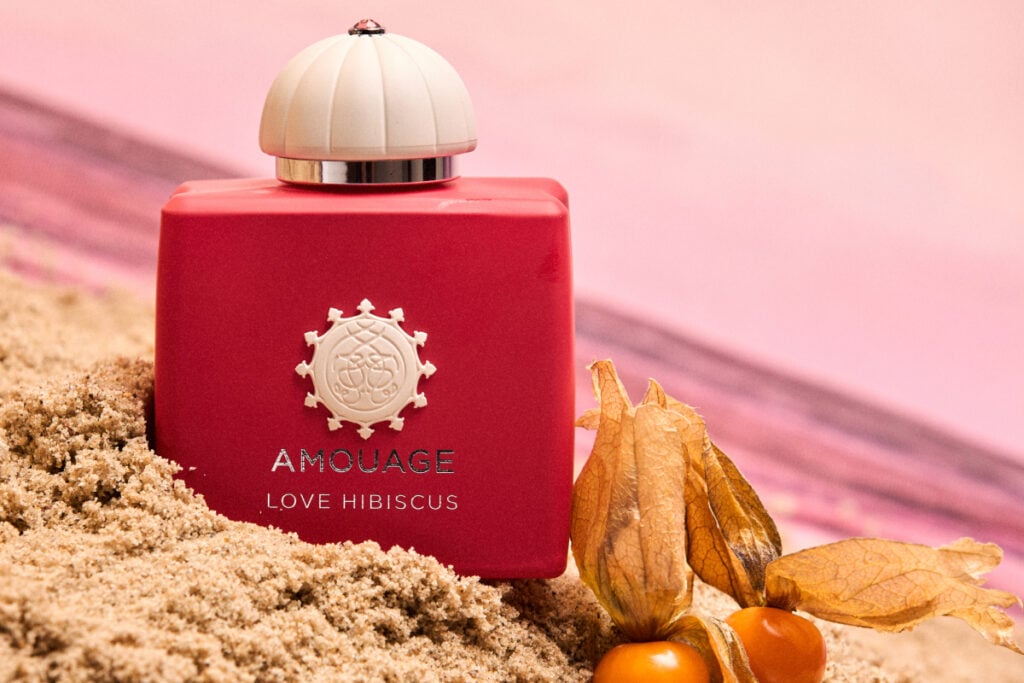
Amouage was founded in 1983 in Oman as a gift from Sultan Qaboos to the world: a perfume house representing Omani olfactive excellence at the highest possible level. The first formula, Gold, was created by Guy Robert using ingredients of uncompromising quality: Taif rose absolute, labdanum, ambergris. It was literally the most expensive perfume in the world at its launch.
Today, Amouage is one of the most respected independent houses globally, with a clear philosophy: real ingredients in meaningful concentrations, genuinely complex formulas, and an attention to longevity and skin evolution that makes no concessions to trend.
Guidance is one of the Amouage fragrances available at The Scent Nest and a strong example of the house's philosophy applied to a contemporary profile. The opening combines pear, hazelnut, and osmanthus: a warm, accessible, slightly fruity entry. The heart brings rose and saffron, the two pivot ingredients of classic Arabic perfumery. The base settles into labdanum and sandalwood, resinous and warm, with a skin presence that carries through the day.
The overall sensation is structured elegance: not a fragrance that overwhelms, but one that unfolds gradually and gains complexity over time. Ambition without noise.
For those who want to explore a more concentrated dimension, Guidance 46 is the Extrait de Parfum version. Formulated with bitter almond, pink pepper, saffron, jasmine, akigalawood, amber, and labdanum, it is darker, heavier, slower to unfold. The opening has spice and shell fruit; the base arrives at an animalic, resinous depth that is the closest thing in the catalog to traditional oud-heavy Arabic perfumery. Same fragrance, different mood: more night than day.
How to explore Arabic fragrances if you are unfamiliar
The most common mistake for someone coming from mainstream perfumery is to test an Arabic-style fragrance on a paper strip and decide within three minutes. It does not work. Oud on paper can be harsh, almost unpleasant; on skin, after two hours, it becomes warm, rounded, intimate. Taif rose on paper can read as overly sweet; on skin, combined with body temperature, it becomes floral-spiced in a way that resembles nothing in European perfumery.
The rule is the same as for any niche fragrance, but more important here: test on skin, allow at least a full day, and judge the base, not the opening. Arabic fragrances are built for their base and longevity, not the first fifteen minutes.
At The Scent Nest, Guidance is available as a 2 mL sample from 13.50 EUR, and Guidance 46 from 17.00 EUR for 2 mL. Both give you enough fragrance for 5 to 7 full wears, sufficient to experience the complete evolution across different conditions.
Other fragrances in our catalog with Arabic influences
Nishane is an Istanbul house operating at the intersection of the Middle East and Europe. Ani by Nishane: bergamot, cardamom, and vanilla; not a classic Arabic fragrance, but its spiced-fruity character and high longevity clearly reflect the influence of Oriental tradition. An accessible entry point for someone who wants to approach the spiced register without going directly into oud territory.
If you want to explore more broadly, amber fragrances and those in the woody family cover a large part of what makes Arabic perfumery recognisable, even in Western formulas that draw on this tradition.
Closing thoughts
Arabic perfumery is not a trend and not a niche in a dismissive sense. It is one of the oldest and most sophisticated olfactive traditions in the world, built on real ingredients, serious concentrations, and a philosophy of skin presence that makes no apologies. What modern niche perfumery has achieved, above all through houses like Amouage, is to make this tradition accessible and recognisable to a wider audience without sacrificing its core.
If you have ever thought that oud was too much, or that Oriental fragrances were not for you, it is worth returning to the subject with a good sample and a free day. Your skin might have a different opinion.
Frequently asked questions about Arabic fragrances
What is oud and why is it so expensive?
Oud (or agarwood) is a resin produced by the Aquilaria tree in response to infection or stress. Not all trees produce it, the process takes years or decades, and wild Aquilaria trees are endangered. The combination of rarity, extraction difficulty, and aromatic intensity places it among the most expensive perfumery ingredients in the world.
Are Arabic fragrances suitable for Romanian weather?
Yes, with a seasonal adjustment. Dense, resin-floral formulas with oud and amber work best in autumn and winter, when lower temperatures moderate projection and allow warm bases to unfold slowly. In summer, the same formulas can become overwhelming; lighter Oriental variants with rose and saffron but without heavy oud, or Oriental fragrances layered with musk and citrus, are more wearable in the heat.
What is the difference between Guidance EDP and Guidance 46 Extrait?
Guidance EDP has a more accessible, fruity opening with pear, hazelnut, and osmanthus, evolving toward rose-saffron and a base of labdanum and sandalwood. Guidance 46 Extrait is a different formula, not simply a more concentrated version: it features pink pepper, bitter almond, akigalawood, and a more pronounced animalic presence in the base. The EDP is brighter and more contemporary; the Extrait is deeper and more traditionally oriented. Both are available as samples at The Scent Nest.
Can I wear an Arabic fragrance to the office?
It depends on the formula and the dose. Guidance EDP, applied with restraint, has a generous but not aggressive projection suitable for a work environment. Guidance 46 Extrait is better suited for evenings or occasions where fragrance presence is part of the look. The general rule for intense fragrances: use half the amount you would apply for a fresh fragrance.
Where can I buy Arabic niche fragrances in Romania?
The Scent Nest carries a selection of Arabic and Oriental-influenced fragrances, including Amouage Guidance (13.50 EUR for 2 mL) and Guidance 46 (17.00 EUR for 2 mL), available as samples before committing to a full bottle.